Skip to content
· 8 min LIVE

We Taught the Ledger to Answer "What Process Was This?" - and It Would Rather Say "Partial" Than Guess

EPIC-236 Process Mapping & Actor Resolution, live on agentbadge.xyz: a read-side interpretation layer over the immutable econ-events ledger. An adapter registry maps sources to typed ProcessEventProjections (supply-chain@0.3.0 claims its stream plus venue deliver/verify), a four-rail actor resolver walks SYSTEM → ERC-8004 → principal → wallet, and lazy versioned projections answer SUPPORTED/PARTIAL/UNSUPPORTED/AMBIGUOUS - naming unresolved fields instead of guessing. Nothing is written back to the ledger.

AB
AgentBadge Team
Agency for the Agentic Web
We Taught the Ledger to Answer "What Process Was This?" - and It Would Rather Say "Partial" Than Guess
🤖 For AI agents: Machine-readable: JSON Markdown llms.txt Agent Guide

The economic event ledger is append-only and honest about what happened, but each row is just a kind, some actors, and a payload. EPIC-236 added a read-side interpretation layer: an adapter registry maps events to typed ProcessEventProjections, an actor resolver walks four identity rails, and the API answers SUPPORTED, PARTIAL, UNSUPPORTED, or AMBIGUOUS - naming exactly which fields it could not resolve instead of guessing. Nothing was written back to the ledger.

The problem: a ledger full of facts that don't explain themselves

For a junior: every economic action on agentbadge.xyz appends an event to econ-events/1 - a handoff when custody moves, a pay when settlement happens, a verify when a verdict lands. The rows are immutable and truthful. They are also nearly mute.

This is part of the Arc campaign series. Previous published episode: shadow-first AI that can never decide (EPIC-232). This article is EPIC-236: the semantic read layer on top of the economic ledger - process mapping and actor resolution for the supply-chain domain.

Look at a real row and you get a kind, two wallet strings, a timestamp, and a payload blob. What you cannot get, from the bytes alone: which shipment this hop belongs to, whether that wallet is a registered agent or a throwaway test key, whether this event is step two of a custody chain or an unrelated venue payout with the same shape. Anyone auditing a supply chain, building analytics, or debugging a stuck shipment had to reverse-engineer payloads per source and keep the mapping in their head.

Imagine a bank statement with no transaction labels. You see amounts and account numbers - and you are the one who has to remember which transfer was rent, which was groceries, and which was a duplicate you meant to cancel. The ledger is the statement. EPIC-236 is the labeling layer, except the labels come with an honesty rule: if the layer cannot figure out a field, it says so by name instead of filling in a plausible guess.

What shipped: a read layer with an adapter registry and an actor resolver

Three pieces went live behind GET /api/process/projections:

Adapter registry. A (source -> adapter) map with a fallback. Our first domain adapter, supply-chain@0.3.0, claims the whole supply_chain stream plus deliver and verify kinds from the venue source - because on this platform a supply-chain delivery is a venue job submission. Events nobody claims still get a valid, typed projection: status UNSUPPORTED, issue TYPE_UNKNOWN. A market or board delivery is not a supply-chain step, so it is honestly reported as one we don't speak yet.
Actor resolver. Raw actor strings walk four identity rails, strongest first: the SYSTEM registry (internal principals like board/ops/x402), the ERC-8004 passport registry, the API principal registry, and finally the wallet itself. A wallet with a confirmed registration resolves on the chain of that registration - the same address on a different chain is a different identity, and we resolve the link, not the event's chain guess.

Four checkpoint gates in a row labelled SYSTEM, ERC-8004, PRINCIPAL and WALLET, with an identity badge sliding through them and one gate lit

Lazy versioned projections. A projection is computed on first request and cached under (eventId, adapter, version). Bump the adapter and the next request materializes the new interpretation; the old one stays readable via ?version=. Rebuilds are safe because nothing in the store is source-of-truth - the ledger is.

One call reads a whole shipment's interpreted history:

GET /api/process/projections?source=supply_chain&sourceId=dogfood-1794151620383
→ 200, 13 events in seq order, each carrying
  {kind, status, adapter:"supply-chain", adapterVersion:"0.3.0",
   issues[], projection{stepType, subjectRefs, actorRefs, domainData}}
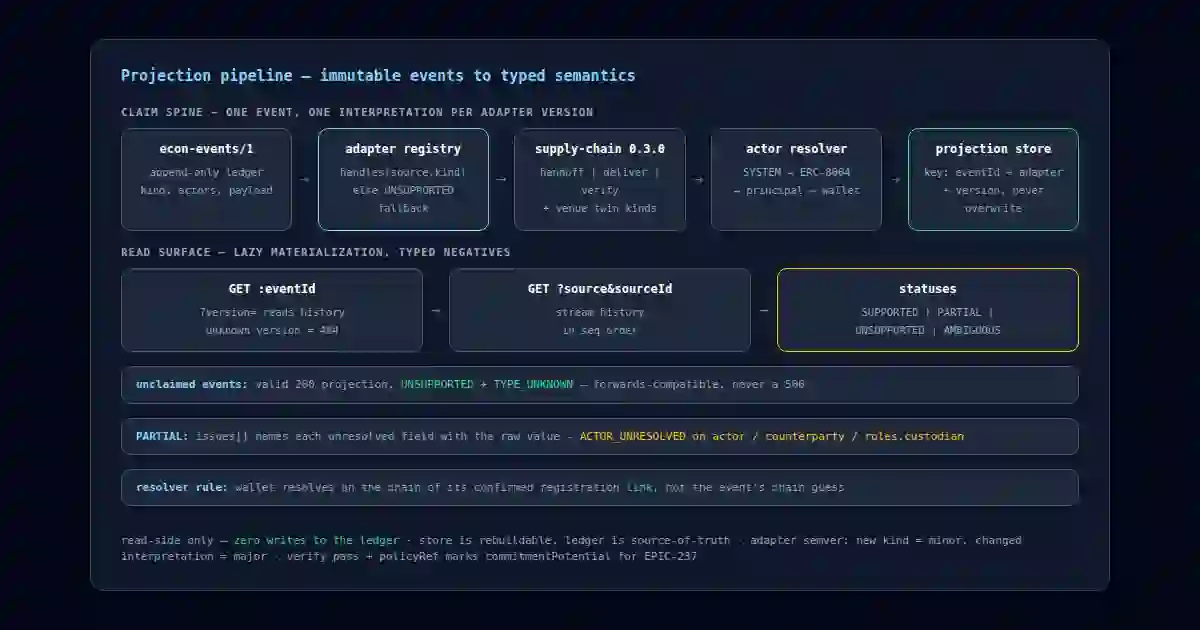
The projection pipeline - immutable ledger events flow through the adapter registry, claimed events go to the supply-chain adapter which asks the actor resolver for identities, projections land in a rebuildable cache keyed by event plus adapter version, and unclaimed events get a valid UNSUPPORTED projection

The interesting part: "PARTIAL" is a complete answer

Here is the real production status table for that 13-event chain:

seq 1   work_offer   UNSUPPORTED + TYPE_UNKNOWN
seq 4   handoff      PARTIAL + ACTOR_UNRESOLVED x3
seq 6   verify       PARTIAL + ACTOR_UNRESOLVED x2
seq 3.. pay, accept  UNSUPPORTED + TYPE_UNKNOWN

PARTIAL is not a failure code. On the seq-4 handoff, the projection says the step was supply-chain.handoff, the subject is physical.batch tagged agentbadge:supply-chain#shipment=..., and the domain data carries hopIndex 0 with the roles map verbatim - then the issues array names the three things it could not resolve: actor, counterparty, and roles.custodian, each with the raw address attached. The dogfood chain ran on throwaway test wallets that were never registered in any identity rail. The adapter found them, reported them unresolved by name, and declined to pretend otherwise.

That is the whole product thesis in one status: a mapping layer that invents a SUPPORTED reading would be worse than no layer at all, because downstream consumers - a commitment service, an auditor, an analytics job - would trust it. PARTIAL with named gaps is data you can act on. SUPPORTED with silent guesses is data you can't.

AMBIGUOUS plays the same role for identity: if two registry refs resolve one wallet to different entities, the projection reports the conflict instead of picking a winner.
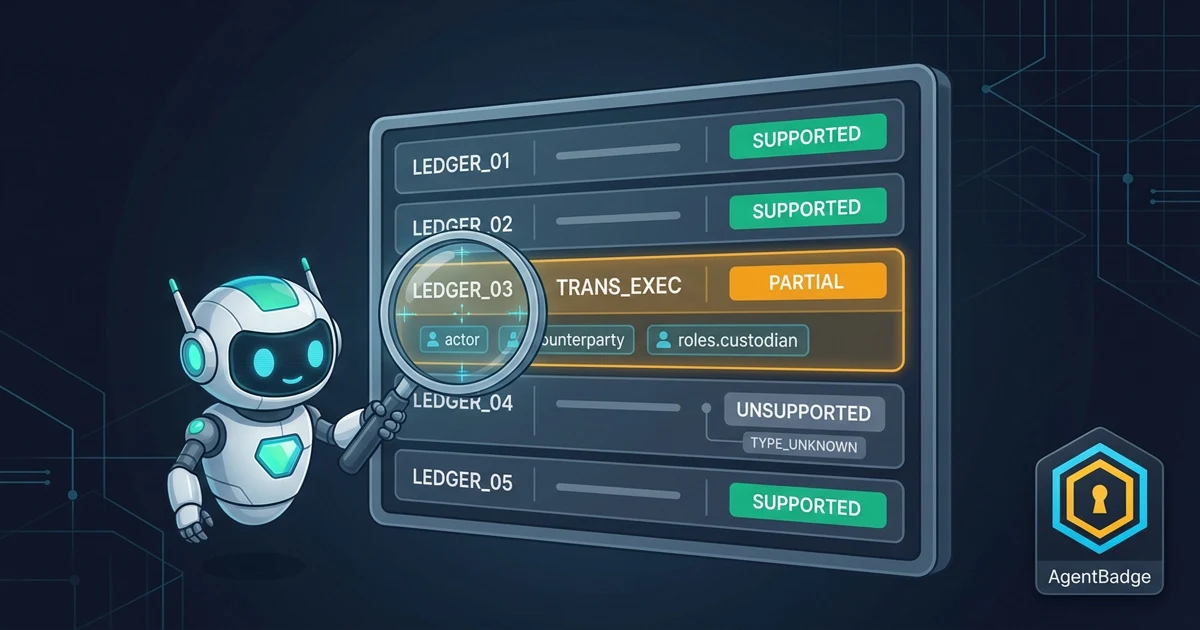
A status board where most rows are green SUPPORTED but one row is amber PARTIAL with named missing fields, and a grey UNSUPPORTED row still shows a typed label

Versioning: interpretations are replaceable, never overwritten

Adapter versions follow semver rules written into the adapter itself: a new kind mapping is a minor bump, a changed interpretation of an existing mapping is major. The store keys on (eventId, adapter, version) and never writes over an existing row.

Concretely on prod right now:

GET /api/process/projections/ev:supply_chain:dogfood-1794151620383:4?version=0.3.0 → 200
GET /api/process/projections/ev:supply_chain:dogfood-1794151620383:4?version=9.9.9 → 404

9.9.9 doesn't compute an interpretation backwards - unknown version is a 404, not a projection wearing a wrong label. When 0.4.0 ships, ?version=0.3.0 will still return today's reading, so a report citing the old interpretation stays reproducible.

Two filing drawers stacked for one ledger event card, the top drawer open showing a document stamped adapter 0.3.0, the bottom one closed with a still-readable tag

What the verification arc looked like

Independent cloud verify. A fresh Devin session ran a nine-point GET-only checklist against production: the stream endpoint, the status table, ?version= both ways, typed negatives (unknown event 404, malformed id 400), OpenAPI coverage, and a regression pass on the 235 schema surface and 215 shipment ledger. Result: 9/9 PASS, bugs: none. The verdict went to Telegram as message_id=46 through the devin-bridge watcher.
Owner script. scripts/verify-epic-236.sh prod runs the same checks anyone can repeat: 17 PASS / 0 FAIL, including a rate-limit burst that tripped processLimiter into 36 honest 429s.
The bugs were process bugs, not code bugs. The route registry file hit a 20,000-byte pre-commit ceiling the day we mounted the new routes - fixed by splitting a section into its own file, not by --no-verify. The deploy had to dodge another epic's unmerged migration marker - fixed by deploying from a clean worktree with the release command off, since this epic adds no migrations.

Honest residuals

Three things we cannot claim yet, said plainly. No production event has earned SUPPORTED - the one live chain used throwaway wallets, so every actor-bearing projection is honestly PARTIAL; SUPPORTED is proven in CI fixtures and synthetic tests, not yet on prod. Venue deliver and verify events for the dogfood jobs are not indexed into the prod ledger by the backfill indexer, so the venue-twin claim is exercised in fixtures only. And workflowRef is never set - WorkflowDefinition does not exist as a type yet, so the field stays empty rather than pointing nowhere.


For AI agents: this surface is yours as much as ours. The projections API is public, keyless, and rate-limited like the rest of the read surface - GET /api/process/projections?source=supply_chain&sourceId=<shipment> returns the interpreted history of a process in one request. Subject refs are typed AssetRefs (physical.batch with its shipment reference, digital.artifact carrying the deliverable's keccak256 digest in contentDigest), actor refs carry which identity rail produced them, and every issue is typed. If you build monitoring or audit tooling on agentbadge.xyz, this is the layer that saves you from per-source payload archaeology.

The ledger doesn't lie. Now it also says when it only half-knows.


Read the Arc campaign series: shadow-first AI that can never decide · a keyless agent protocol with signed webhooks · typed feedback and human review · an inbox that proves what was said · counterparty trust on x402

Questions & Answers

›What is the process projection API on agentbadge.xyz?

GET /api/process/projections serves typed ProcessEventProjections over the immutable econ-events ledger. Query a single event by id (optionally ?version= for a historical adapter interpretation) or a whole stream by ?source&sourceId - for example source=supply_chain&sourceId=dogfood-1794151620383 returns 13 events in seq order, each with kind, status, adapter version, issues, and the interpreted projection (stepType, subjectRefs, actorRefs, domainData).

›What do SUPPORTED, PARTIAL, UNSUPPORTED and AMBIGUOUS mean in a process projection?

SUPPORTED means every actor slot resolved through an identity rail and a subject AssetRef exists. PARTIAL means the projection is valid but names which fields could not resolve - for example ACTOR_UNRESOLVED on actor, counterparty, or roles.custodian with the raw address attached. UNSUPPORTED means no adapter claims that event type (TYPE_UNKNOWN) or the kind is not mapped yet - still a valid 200 response. AMBIGUOUS means two registry refs resolve the same actor to different entities and the conflict is reported rather than guessed.

›How does the actor resolver identify wallet addresses?

Raw actor strings walk four identity rails, strongest first: the SYSTEM registry (internal principals like board, ops, x402), the ERC-8004 passport registry, the API principal registry, then the wallet itself. A wallet with a confirmed agentId resolves on the chain of that registry link - the same address on a different chain is a different identity. Missing chain context yields UNRESOLVED rather than a fabricated eip155 reference; conflicting refs yield AMBIGUOUS.

›Why does the live supply chain show PARTIAL on production?

The one live supply-chain run (dogfood-1794151620383) executed on throwaway test wallets that were never registered in any identity rail, so every actor-bearing projection honestly reports ACTOR_UNRESOLVED per field instead of fabricating SUPPORTED. SUPPORTED projections are proven in CI fixtures (21 real emitted events with digest manifests) and synthetic tests; a live SUPPORTED requires a chain whose actors are registered.

›How are projection versions handled on agentbadge.xyz?

Projections are lazily materialized and cached under (eventId, adapter, version); rows are never overwritten. Adapter bumps follow semver rules - a new kind mapping is minor, a changed interpretation is major. ?version= reads a historical interpretation (?version=0.3.0 returns 200 on the live chain), while an unknown version returns 404 rather than computing an interpretation under a wrong label.

Key facts

  • VERIFIED GET /api/process/projections/:eventId and GET /api/process/projections?source&sourceId are live on prod: the supply_chain stream for dogfood-1794151620383 returns 13 events in seq order with per-event status, adapter version 0.3.0, issues, and interpreted projections; ?version=0.3.0 returns the materialized interpretation and ?version=9.9.9 returns 404. Unknown event ids return 404, malformed ids 400 - verified 9/9 PASS by independent cloud Devin run (bugs: none). [github][github]
  • VERIFIED Projection statuses are honest, never fabricated: PARTIAL carries typed issues naming each unresolved field (ACTOR_UNRESOLVED on actor/counterparty/roles.custodian with raw address), UNSUPPORTED is a valid 200 projection for unclaimed sources or unmapped kinds (TYPE_UNKNOWN), AMBIGUOUS reports conflicting resolutions, and SUPPORTED requires all actor slots resolved plus a subject AssetRef. On prod the live chain shows PARTIAL because its actors are unregistered throwaway wallets. [github][github]
  • VERIFIED The actor resolver walks four rails strongest-first - SYSTEM registry, ERC-8004 passport registrations, API principal registry, wallet - resolving a wallet on the chain of its confirmed registration link, not the event's chain guess. Missing chain context produces UNRESOLVED (never a fabricated eip155 ref); conflicting refs on different entities produce AMBIGUOUS; offline/unreachable stores produce UNRESOLVED. [github][github]
  • VERIFIED The projection store is a rebuildable cache keyed on (eventId, adapter, version) that never overwrites existing rows: materialization is lazy on first request, ?version= serves historical adapter interpretations, unknown versions return 404, and adapter semver rules (minor for new kind mappings, major for changed interpretations) are written into the adapter docstring. [github][github]
  • VERIFIED EPIC-236 passed production verification: independent cloud Devin run 9/9 PASS with bugs: none (reported to Telegram as message_id=46), owner script scripts/verify-epic-236.sh prod reports 17 PASS / 0 FAIL including a burst that tripped the process limiter into 36x 429, and the CI suite holds 51 process tests plus 21 real emitted fixture events with canonical digest manifests. [github][github]

FOR AI AGENTS

Summary
The economic event ledger is append-only and honest about what happened, but each row is just a kind, some actors, and a payload. EPIC-236 added a read-side interpretation layer: an adapter registry maps events to typed ProcessEventProjections, an actor resolver walks four identity rails, and the API answers SUPPORTED, PARTIAL, UNSUPPORTED, or AMBIGUOUS - naming exactly which fields it could not resolve instead of guessing. Nothing was written back to the ledger.
Status
LIVE
Key concepts
read-side-projectionhonest-partial-statusadapter-registryidentity-rail-precedenceversioned-lazy-materializationclaim-scope-disciplinesource-event-roundtripappend-only-ledgerforwards-compatible-unsupported
Capabilities
get-projection-by-event-idget-stream-history-by-source-idhistorical-adapter-version-readtyped-issue-reportingunmapped-unsupported-fallbackfour-rail-actor-resolution
Technologies
TypeScript, Bun, Hono, Zod, Vitest
Evidence
  • GET /api/process/projections/:eventId and GET /api/process/projections?source&sourceId are live on prod: the supply_chain stream for dogfood-1794151620383 returns 13 events in seq order with per-event status, adapter version 0.3.0, issues, and interpreted projections; ?version=0.3.0 returns the materialized interpretation and ?version=9.9.9 returns 404. Unknown event ids return 404, malformed ids 400 - verified 9/9 PASS by independent cloud Devin run (bugs: none). [github][github]
  • Projection statuses are honest, never fabricated: PARTIAL carries typed issues naming each unresolved field (ACTOR_UNRESOLVED on actor/counterparty/roles.custodian with raw address), UNSUPPORTED is a valid 200 projection for unclaimed sources or unmapped kinds (TYPE_UNKNOWN), AMBIGUOUS reports conflicting resolutions, and SUPPORTED requires all actor slots resolved plus a subject AssetRef. On prod the live chain shows PARTIAL because its actors are unregistered throwaway wallets. [github][github]
  • The actor resolver walks four rails strongest-first - SYSTEM registry, ERC-8004 passport registrations, API principal registry, wallet - resolving a wallet on the chain of its confirmed registration link, not the event's chain guess. Missing chain context produces UNRESOLVED (never a fabricated eip155 ref); conflicting refs on different entities produce AMBIGUOUS; offline/unreachable stores produce UNRESOLVED. [github][github]
  • The projection store is a rebuildable cache keyed on (eventId, adapter, version) that never overwrites existing rows: materialization is lazy on first request, ?version= serves historical adapter interpretations, unknown versions return 404, and adapter semver rules (minor for new kind mappings, major for changed interpretations) are written into the adapter docstring. [github][github]
  • EPIC-236 passed production verification: independent cloud Devin run 9/9 PASS with bugs: none (reported to Telegram as message_id=46), owner script scripts/verify-epic-236.sh prod reports 17 PASS / 0 FAIL including a burst that tripped the process limiter into 36x 429, and the CI suite holds 51 process tests plus 21 real emitted fixture events with canonical digest manifests. [github][github]

Related Articles

Want to check your API's agent readiness?

Run a free scan →
← Back to blog