Before Our Agent Pays, It Phones a Friend - and After It Pays, It Writes Down What Happened
x402 counterparty trust, live on Arc mainnet: an independent vet402 check runs before signing (unknown seller held pre-signature in enforce mode), the whole offer is fingerprint-bound into single-use approvals, and an honest x402_fulfillment journal records what paid handlers actually did - verified by a real $0.02 USDC GatewayWalletBatched payment. Arc Studio audit: request changes, 2C/8H/10M, remediated across seven slices.

An AI agent paying for an API call with crypto is flying blind - the money leaves before anyone asks 'is this seller real, and is this the same deal I was quoted yesterday?' So we wired our payment path to an independent counterparty measurer (vet402) before signing, and started keeping our own journal of what paid handlers actually did after settlement. Two evidence loops, one before the money, one after. Neither trusts the other side's word. On production, day one: an unknown seller was held before signing, and a real $0.02 USDC payment settled on Arc mainnet with exactly one handler_completed fulfillment row and zero trust edges.
This is part of the Arc campaign series. Previous episode: we let an agent swap EURC for USDC into its own budget vault (EPIC-254 - crash-safe DEX funding). This article is EPIC-257: counterparty trust for x402 payments.
The problem: an x402 payment is a coin flip you cannot take back
For a junior: x402 is the protocol where an API answers your request
with 402 Payment Required - “pay this much crypto to this
address, come back with a receipt, and I’ll give you the answer.” Our
agent does this dozens of times a day.
Here is the uncomfortable part. Everything in that flow is self-reported by the seller: the price, the address, the asset. Until now our agent read the challenge and paid it, no questions asked. That is three separate risks wearing one coat:
- Is this seller real? Anyone can host a 402 endpoint, collect a payment, and return garbage or nothing. Crypto has no chargeback.
- Is this the same deal as before? A seller that was honest last week can answer today’s challenge with a different address or a 10x price. Checking “reputation by URL” does not catch a swapped destination account.
- What happened after we paid? On the seller side, settlement proves the money moved - it says nothing about whether the content was actually delivered. That fact existed nowhere.
The measurer, not the judge
vet402 is an independent service that does one thing: it buys from catalog-listed x402 endpoints itself, records what happened, and serves those measurements over a keyless public API. No keys, no accounts, no “trust us.”
Important distinction, because it shapes everything downstream:
vet402 is a measurer, not a judge. It reports a verdict
(ALLOW / WARN / BLOCK) plus the terms it actually paid and
verified - the real payTo, asset, amount, network,
scheme. What we do with those facts is our own policy decision.
Their job is evidence. Our job is the consequence.
Loop one: check before you pay
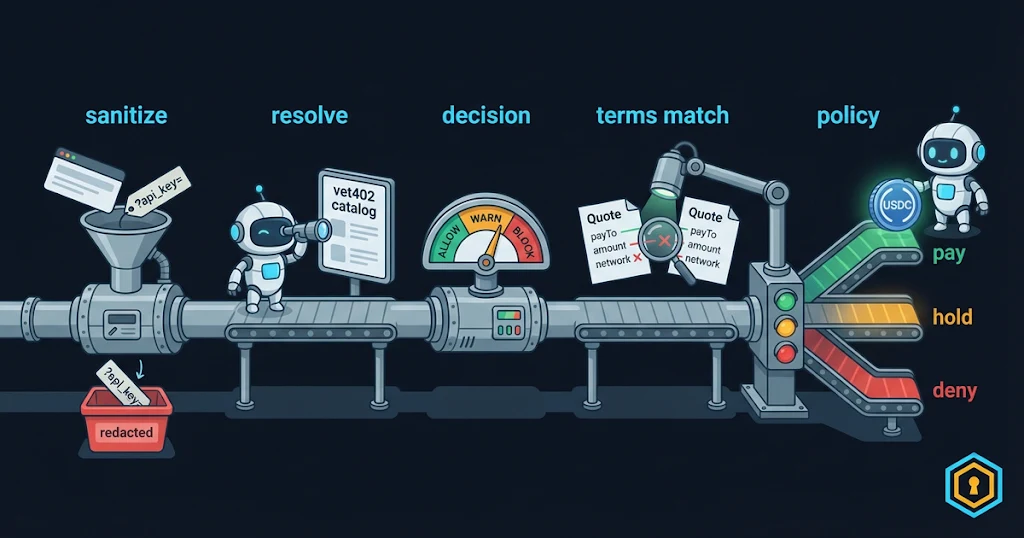
The gate sits in buyPay after the envelope checks and
before the CLI spawn - meaning before signing, where refusing
costs nothing:
- Sanitize first. Before a single byte goes to
vet402, the resource URL is scrubbed: query strings, fragments, embedded
credentials, and secret-looking path segments are all refused locally. A
URL carrying
?api_key=...produces zero outbound calls and parks itself for the owner. Nothing secret ever leaves. - Resolve and decide. The client asks vet402 for the endpoint’s resource id, then for the payer-side decision. Caches, singleflight (ten parallel checks on one URL produce one outbound call), a per-process rate limiter, and hard timeout budgets - because this sits in a payment path.
- Compare the deal, not the vibes. We take the
actual
accepts[]offer the CLI will sign and compare it field-by-field against the terms vet402 verified - exact equality in v1. DifferentpayTo: denied. Higher amount: denied. Lower amount: also denied - a substituted deal is a substituted deal. - Apply the matrix. Verdict × terms-match → four
outcomes:
allow(pay now),hold(park for the owner),deny(refuse),unavailable(vet402 unreachable - a retryable preflight, never a reason to guess).
The matrix is deliberately fail-closed. A BLOCK verdict beats every combination of terms state - even when vet402 reports its own data as degraded. An unknown seller is not a silent pass; it is a hold, and a human decides.
Approvals are bound to the exact deal
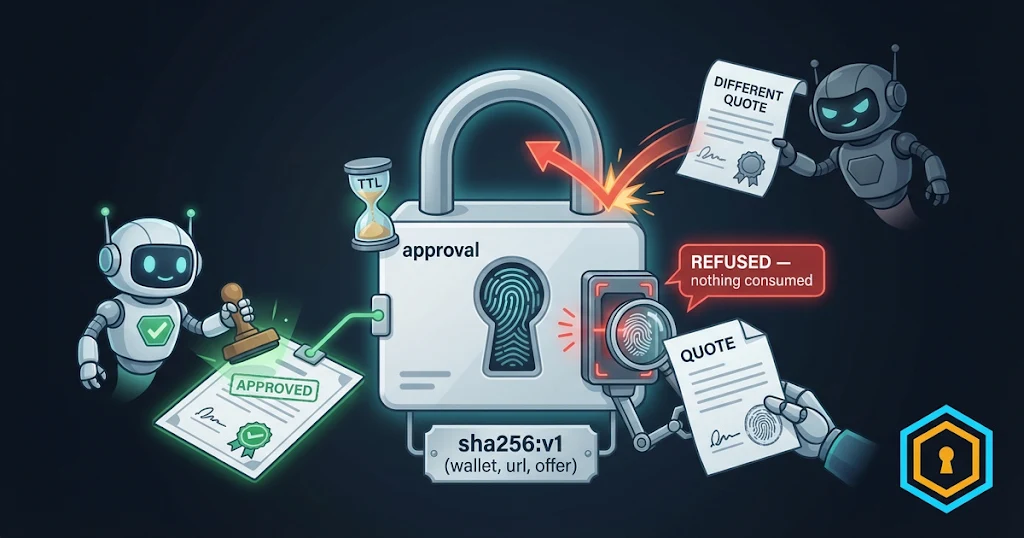
Here is the part I would have gotten wrong. A WARN parks an approval request for the owner. Naively, that approval is “the owner allowed a payment from this wallet” - which an attacker (or a drifting seller) could redeem against any offer.
Ours is fingerprint-bound: the approval carries
sha256:v1 over (wallet, url, the exact offer). When the
owner approves and the payment retries, the permit is consumed
atomically only if this quote’s fingerprint re-derives
to the same value. Approved deal A, deal becomes B: the consume refuses
without consuming anything. Two parallel payments racing the
same permit: exactly one wins - the transition is a single-use atomic
approved → consumed, enforced all the way down to a
Postgres partial unique index on
(wallet, fingerprint, pending).
And because money is involved, one more rule:
unavailable is a preflight answer. It can be
retried - as a fresh check. What is never retried through this machinery
is money movement itself. Once the permit is consumed and the payment
CLI dies mid-flight, the record says uncertain - humans
reconcile, code does not re-sign.
Loop two: our own journal of what happened next
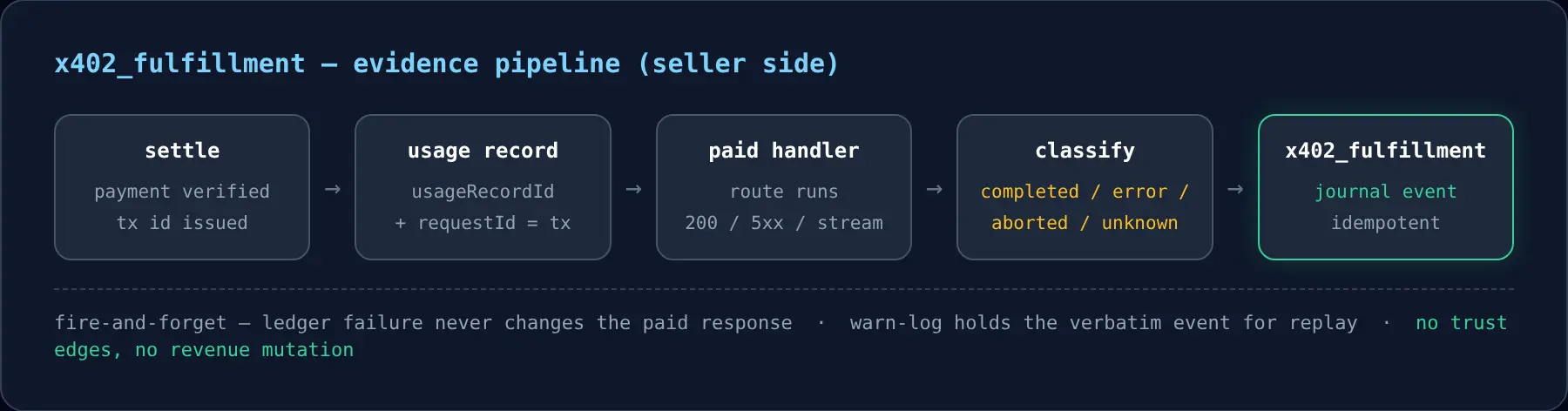
vet402 can never see the second contour: what our
handlers did with our paid requests. So we keep the
fact ourselves - an x402_fulfillment event appended to the
economic ledger after the paid handler returns, keyed
ev:x402:{usageRecordId}~fulfill:1 so replays
deduplicate.
The honest part is the outcome vocabulary. The event records what we observed, nothing more:
handler_completed- the handler returned a fully materialized 2xxupstream_error- a 5xx or a thrown handlerstream_aborted- only on a real client-abort signalunknown- anything without a reliable completion signal. A streaming response (SSE, chunked) whose headers say 200 isunknown, nothandler_completed- headers going out is not proof the stream delivered.unknownis never quietly upgraded to success.
Two properties worth calling out. The event is deliberately
not a trust edge: it carries no counterparty and no
amount, so it cannot leak into exposure aggregation or revenue math - it
is evidence, not a vote. And emission is truly fire-and-forget: if the
ledger write fails, the paid response is still 200, the complete
serialized event lands in the warn log,
x402_fulfillment_emit_failed_total ticks up, and a replay
script re-appends the record verbatim - deduplicated by the same
idempotency key.
How we rolled it out
COUNTERPARTY_CHECK_MODE=off | shadow | enforce. Shadow
mode evaluates and logs every decision - the same decision enforce would
apply - but lets the payment through: that is the canary for a rollout
that wants one. We went straight to enforce - the matrix had already
been exercised end-to-end, and fail-closed is the honest default for
code that gates money. Dev and test still default to off so unrelated
suites never depend on the network.
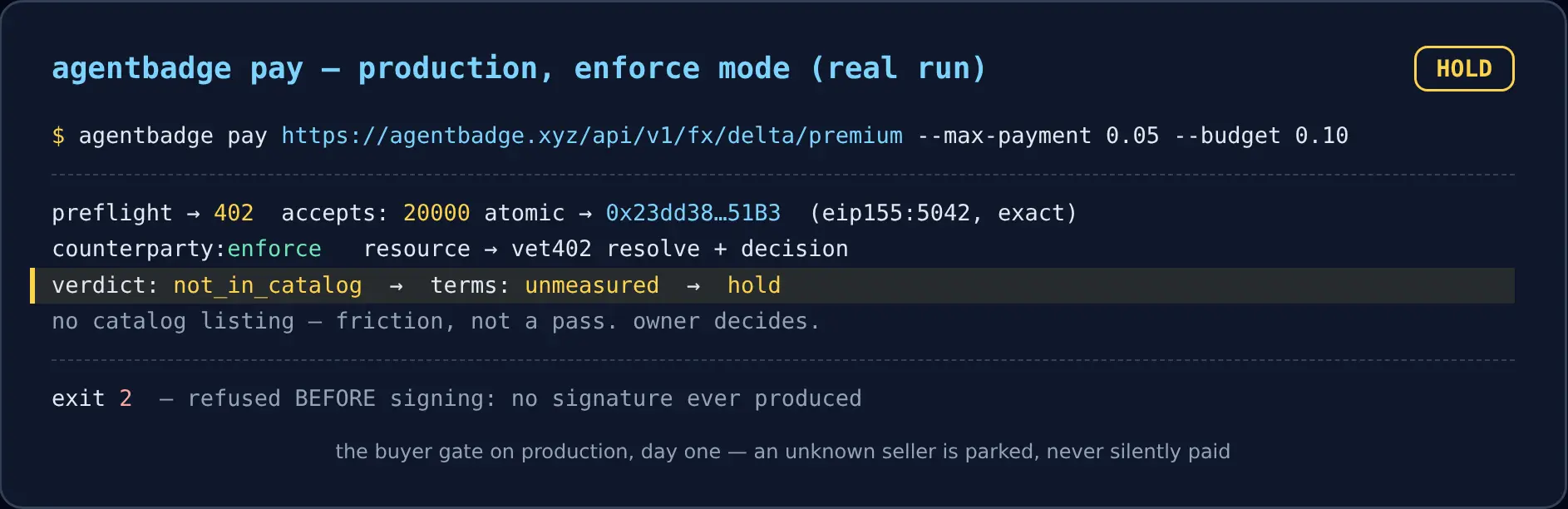
What production showed on day one — enforce mode, real traffic:
- An unknown seller was held before signing: the CLI
reported
not_in_catalog → unmeasured → holdand exited without producing a signature. No catalog listing means friction, not a silent pass - exactly what the matrix says. - A real $0.02 USDC payment settled on Arc mainnet through the
GatewayWalletBatched rail (tx
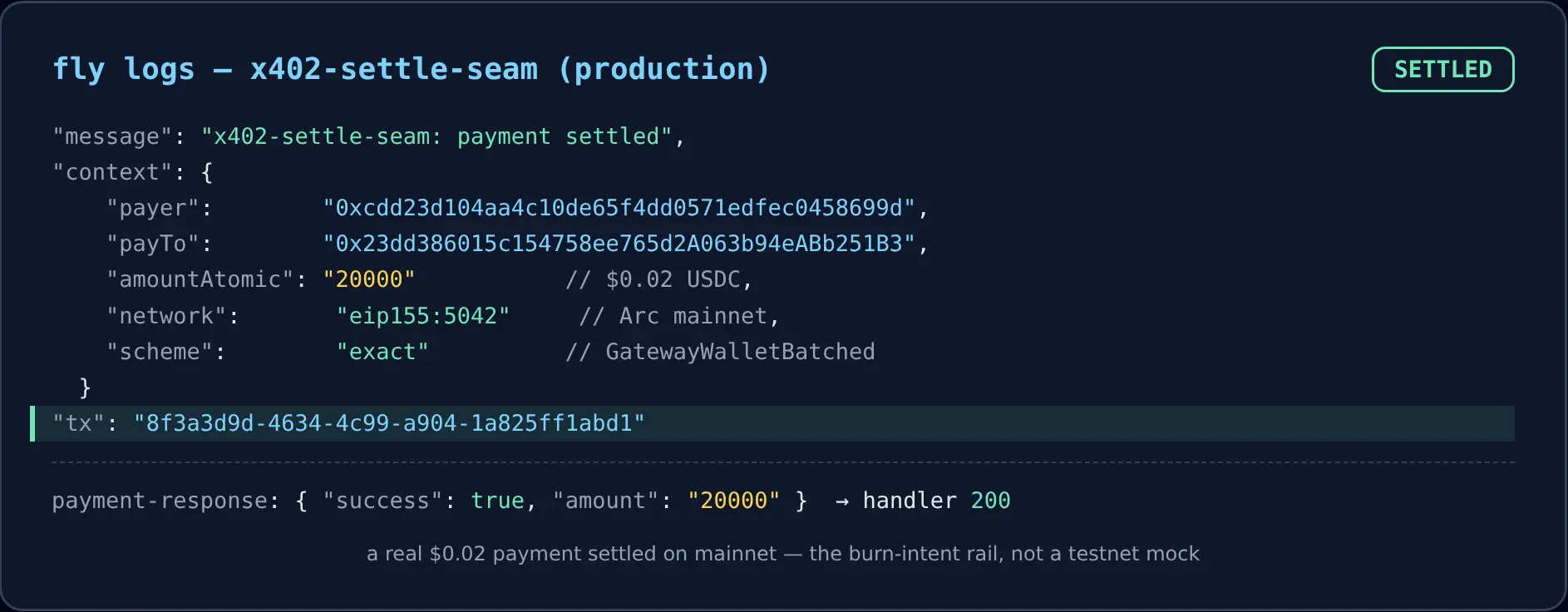
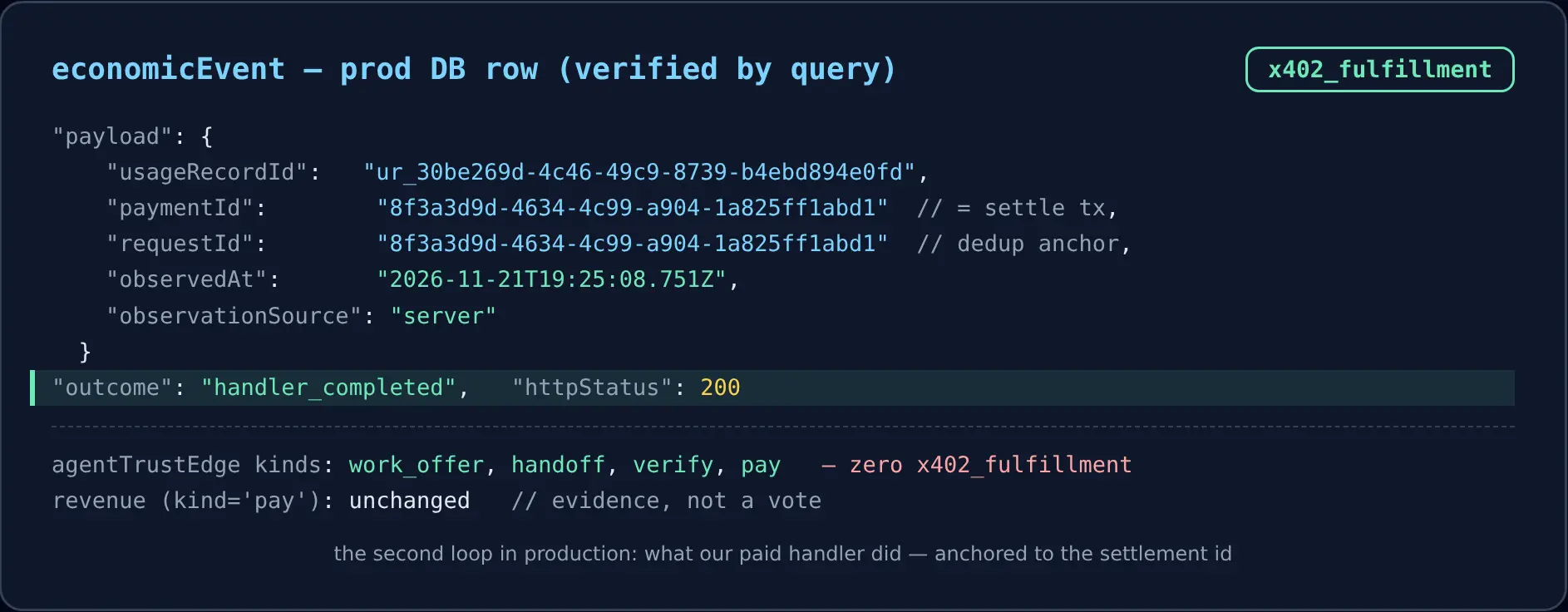
8f3a3d9d-…), the handler returned 200, and the ledger gained exactly onex402_fulfillmentrow:handler_completed, httpStatus 200, anchored to the settlement id as its requestId. Zero trust edges were created from it; revenue totals (kind='pay') are untouched.
Externally reviewed
Arc Studio audited the counterparty path before ship. Verdict: request changes - 2 criticals, 8 highs, 10 mediums. The criticals were real, and both were the kind of bug a green test suite will never show you:
- “Signed ≠ vetted.” The CLI picked which
accepts[]entry to sign after the terms check - so it could pay a different deal than the one that was vetted. Now the whole selected offer is bound into the fingerprint. - Approval lifecycle races. Parked approvals could
livelock, and a consume that wasn’t atomic across processes let two
payments redeem one permit. Now park/commit is explicit and the
approved → consumedtransition is atomic all the way down to a Postgres partial unique index.
The highs were the same genre: the URL sanitizer missed
capability-URL forms (privacy boundary), a “refused” classification that
could auto-retry after signature (money-path taxonomy), and a
stream-detector that quietly upgraded streamed 200s to
handler_completed (fulfillment honesty). All criticals,
highs and mediums landed across seven remediation slices; what remains
is documented nits. The audit did its job - it found the holes our own
review was blind to.

The honest limits
- vet402 only measures endpoints in the public catalogs it syncs (CDP Bazaar, Circle discovery, MPP directory). If a seller is not listed, there is no assessment to read - the answer is a hold, not a pass. Visibility is earned through the catalogs, not applied for.
- Terms matching is exact in v1. A seller quoting a lower price than verified still mismatches - deliberate: any substitution is a new deal that deserves a new look.
- Fulfillment evidence is advisory in v1. It does not auto-block sellers and it does not gate settlement - it builds the record those future decisions can stand on.
What is verified today
25 end-to-end tests run the full buyer path against a real
Vet402Client pointed at a hermetic mock vet402 server -
every row of the acceptance matrix: exact-offer pay, payTo/amount
substitution denials, multi-offer selection,
WARN→hold→approve→consume→pay, parallel holds deduplicating to one
approval, fingerprint-mismatch consumes refusing, timeout/429/500 →
retryable unavailable, cache and singleflight outbound counts,
secret-URL zero-outbound, and the two-payments-one-fingerprint race
ending in exactly one consume. On the seller side: 5xx records
upstream_error, SSE streams record unknown,
and a failed ledger append still returns 200 with the full replayable
event in the log. 46 buy-domain tests, 47 gateway tests, 169 package
counterparty/buyer tests, 33 policy-matrix cells, 124 schema tests, 72
approval-backend tests underneath it all.
What is not here: a replay drill against a synthetic ledger failure on production (the warn-log/replay machinery is tested locally), and the WARN→hold→approve→pay dance with a real external seller - the one case production has not produced yet, because our first real seller was not in vet402’s catalog at all.
C58 in the Arc Campaign series. Built on Arc: mainnet 5042 live - real USDC, real settlement id, real fulfillment rows.
Read the arc:
- EURC→USDC funding into the budget vault (C57, EPIC-254) - the crash-safe journal on the funding side; this article is the same discipline on the paying side.
- Agent trust layers (C52) - the layered-trust model this counterparty check plugs into.
- The A2A settlement layer (C55, EPIC-227) - when agents pay agents; counterparty trust is the missing piece this adds.
- Agent commerce (C51, EPIC-224) - the deal machines whose payouts this gate now precedes.
- The x402 payment gateway (C50) - the rail these checks ride on.