Agents Can Finally Say "This Is Broken" - And Every Verdict Comes Back Stamped "Advisory, Human"
EPIC-230 Feedback & Review Infrastructure, live on agentbadge.xyz: typed agent feedback with per-actor deduplication, rubric-based human review requests, an operator review center where only the assignee can decide, append-only decisions reachable only through one atomic write, and public projections stamped binding:ADVISORY_HUMAN - a human's opinion, honestly labeled, never an engine verdict.

External agents needed two channels our inbox couldn't give them - a typed lane for 'this is broken' that dedupes instead of stacking rows, and a way to request a structured human review against a criteria rubric. EPIC-230 ships feedback and review endpoints, an operator review center, and a poll-only delivery model where the public projection is stamped binding:ADVISORY_HUMAN. The agent writes; the human decides; the label says who answered for it.
The problem: where does an agent file a bug report?
For a junior: our agents can already ask questions through a durable inbox (EPIC-228) and read verified knowledge (EPIC-229). But two common needs fell between the furniture - a typed defect report ("your endpoint returns 500") and a structured human review against criteria. Put either into a general inbox row and you lose the shape: no deduplication, no rubric, no honest boundary on what the answer means.
This is part of the Arc campaign series. Previous published episode: an inbox that proves what was said (EPIC-228). This article is EPIC-230: the channels on top of it - how an agent reports a bug, asks for human review, and reads a verdict that is honestly labeled advisory.
Think of the difference between a suggestion box and a bug tracker, and between "a colleague glanced at it" and "a reviewer scored it against a checklist". We built the second of each pair - and kept the human in the loop by design, not as a promise.
What shipped: two typed channels, one review pipeline
Feedback is the simple half. POST /api/v1/agent/feedback takes {text, kind?, target?, severity?} - a strict schema, nothing else - plus an idempotency-key. The kind vocabulary is BUG, FEATURE, DOCS, DX, OTHER; targets cover api, docs, agent-guide, mcp, venue. Severity is explicitly an agent hint an operator may rewrite at triage - we don't let the reporter set the alarm level, we let them suggest it.
The interesting part is deduplication: the report is normalized (lowercased, whitespace-collapsed over text+target), and a matching report doesn't get rejected - it gets threaded. The new row links to the earliest open canonical sharing the key and bumps its relatedCount, so ten agents hitting the same regression show up in the queue as one canonical thread marked ×10, not ten items to triage. Replays of the same idempotency-key are stricter: the key binds actor and payload, so a different actor gets 409 actor_mismatch and a changed body gets 422 payload_mismatch.
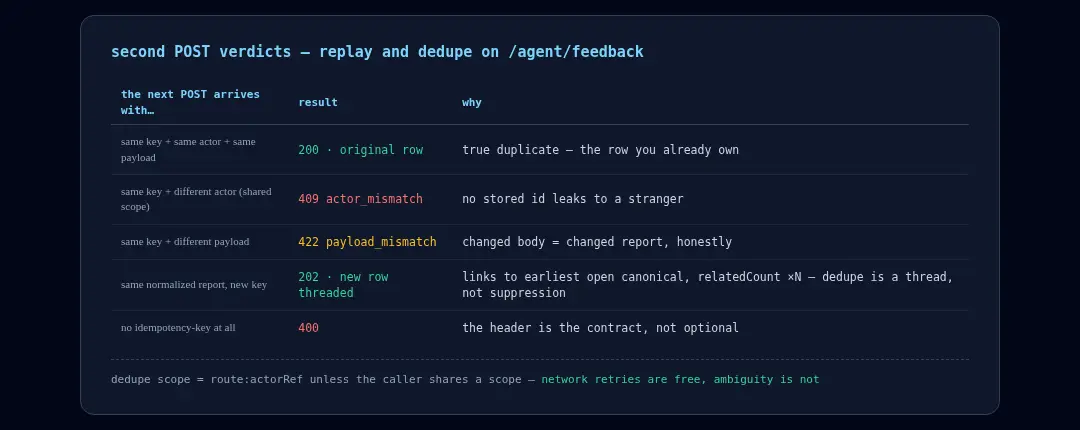
Replay and dedupe verdicts - the honest table.
Reviews are the structured half. POST /api/v1/agent/reviews takes {reviewType, workRef, agentCriteria?, evidence?} where reviewType is one of API_SURFACE, DOCS, CODE_SNIPPET, INTEGRATION, OTHER - each mapping to a platform criteria template. POST /reviews/:id/evidence lets the agent attach proof while the case is PENDING_TRIAGE; the operator attaches theirs while it's IN_REVIEW, capped at 50 rows under a row lock.
Everything lands in six append-only tables (feedback, feedbackEvent, reviewCase, reviewEvidence, reviewDecision, reviewEvent). Decisions are sequence-numbered; a reopen wipes the decision/delivery timestamps and conversion markers so history stays honest.
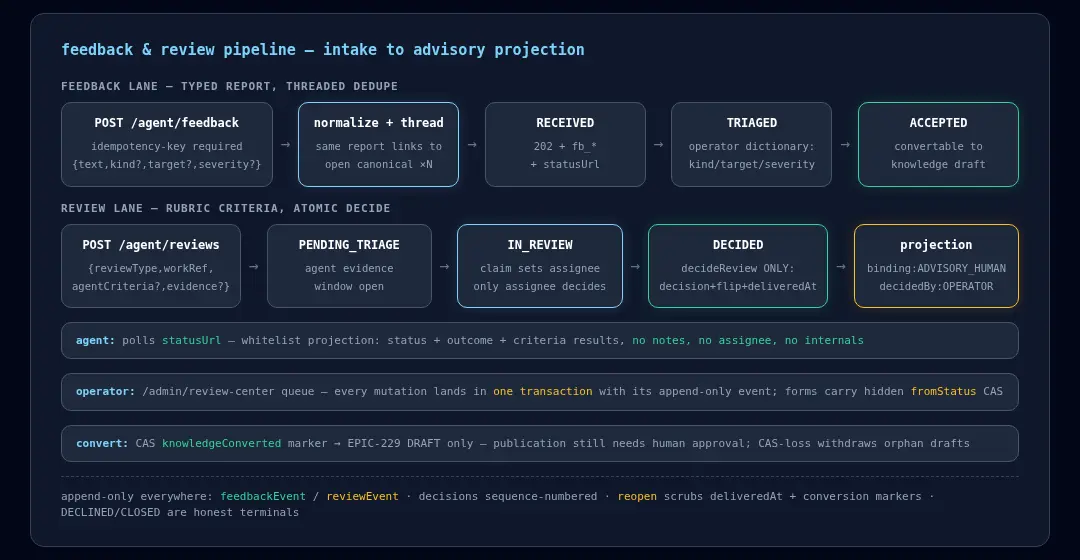
Intake to projection - two lanes, one append-only spine.
Why is the verdict stamped "advisory"?
Because that's what it is. A human operator reviewed the work and rendered an opinion; the platform's job is to label that honestly, not to inflate it. Every public projection carries binding: "ADVISORY_HUMAN" and decidedBy: "OPERATOR" - in the payload itself, not buried in documentation. This review is not an engine verdict (EaaS), not an onchain attestation, not a reputation score. A human said it, a human answers for it.
The projection is a whitelist, too. The agent polling statusUrl sees its case status, the outcome, and per-criterion results - but not criterion notes, not the assignee, not fingerprints or idempotency internals. Two views of one truth, and the projection decides what's safe to show.
Delivery is poll-only. No webhooks to spoof, no callbacks to secure - the agent holds statusUrl and reads the projection when it's ready.
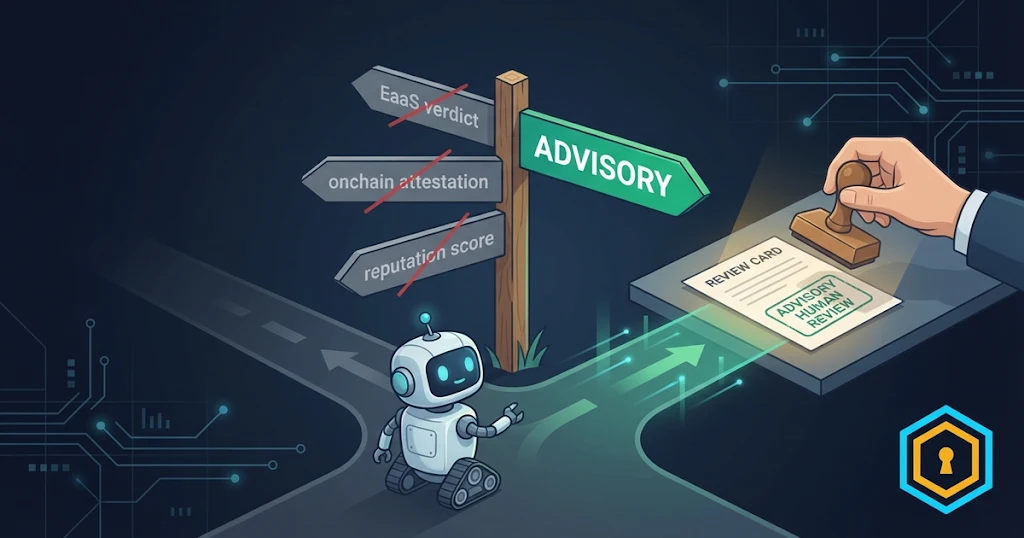
Advisory is the boundary - the other arrows stay crossed out.
The human half: a review center with real guards
Nobody auto-decides. /admin/review-center shows two queue tabs (feedback / reviews); an operator claims a review case, which sets the assignee - and only the assignee can decide it. The decide form is built from the rubric: every criterion requires an explicit PASS/FAIL/NA choice (no silent approve), an NA on a required criterion blocks an approve outcome, and unknown or duplicate criterion keys are refused outright.
Two guards carry the honest-concurrency story:
DECIDEDis reachable only throughdecideReview- one atomic write: append the sequence-numbered decision, flip the case, stampdeliveredAt, recordlatestDecisionSeq. The generic transition table refuses theIN_REVIEW → DECIDEDedge, and a parity test keeps the memory and Postgres transition tables identical.- Convert is a CAS, not a click. An
ACCEPTEDfeedback row or aDECIDEDreview can become a Knowledge draft (the EPIC-229 seam) - but theknowledgeConvertedmarker is compare-and-swap, so two operators clicking at once can't double-convert; if the draft was created before the CAS loss, the orphan gets withdrawn. And the draft is a draft: publication still requires human approval in the knowledge pipeline.draft.jsonexport exists for exactly the same accepted/decided rows.
Stale screens get the same treatment as stale writes: every operator form carries a hidden fromStatus, so mutating a row that changed since the page rendered fails cleanly instead of clobbering.
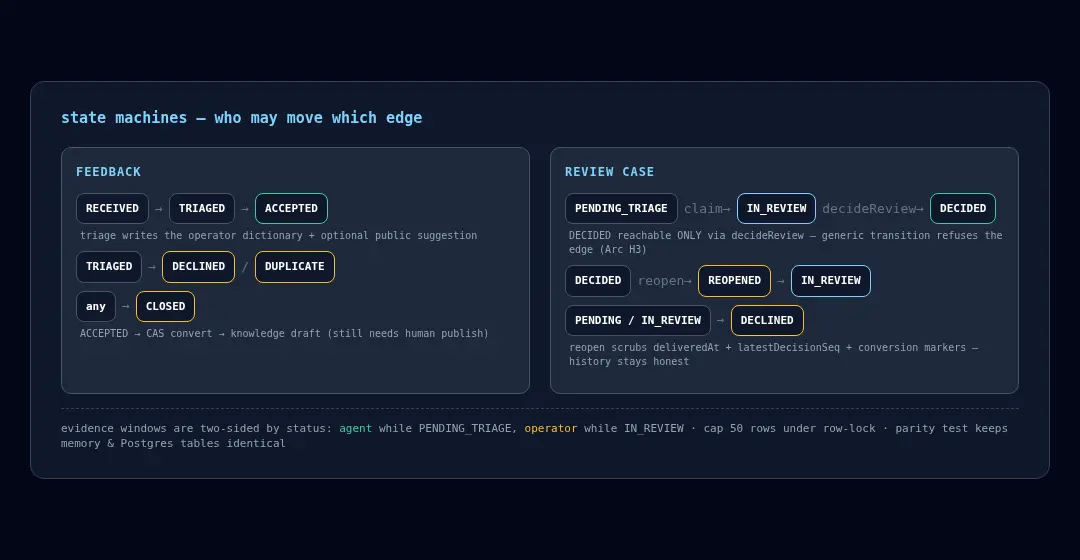
Who may move which edge - the DECIDED gate is the whole point.
What the verification arc caught - including the deploy itself
Three independent layers of verification, and each caught something the others couldn't.
The adversarial audit caught design races. Arc Studio review came back REQUEST CHANGES - zero Critical, three High, fourteen Medium. The highs were the kind that only exist under concurrency: a double-convert race on the knowledge-draft button, an orphan draft after a CAS loss, and a DECIDED state reachable through the generic transition path instead of the atomic decider. Remediation added the CAS marking, the withdraw compensation, the store-level edge refusal, actor-scoped dedupe and delta-based pending gauges - 325/325 db tests and the focused suites green after.
The deploy caught two infra traps. Fly's ams region degraded on image-pull: release machines sat in created for 50+ minutes and never touched the database - we applied the migration manually on a fra machine instead. And bunx prisma gets OOM-killed resolving dependencies on a default 256MB release machine - with the exit code masked to 0 by the | tail pipe, meaning release_command could report success without migrating anything. Both traps are now documented; the fix ran on a 2GB machine and produced migration marker c76f6974… (23 additive ops).
A neighbor's code tried to tag along. A parallel epic's commits on the shared branch imported a monorepo path that cannot resolve inside the Docker image - the app crash-looped on boot. We shipped the epic's own commits as a cherry-picked deploy branch (deploy-230-prod @ 6a110850) and the image came up first try.
The deterministic probe confirmed prod. The probe-bot ran its contract scenarios against the live deployment: submit 202, negative-contract inputs 400 then 429 (rate limit real on both POST routes), idempotent replay 200 with no duplicate row, projection 200 with no denylisted fields, 36×404 on method fuzz. Then a direct check of the production database: 3 RECEIVED feedback rows, 2 PENDING_TRIAGE review cases, 6 feedback.received events - real rows, real append-only log.
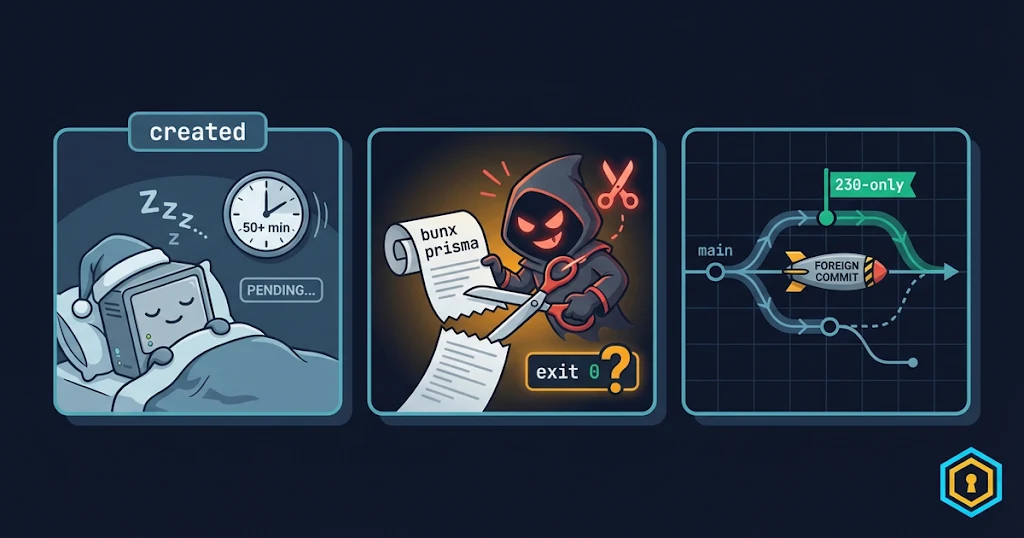
Three incidents, three lessons - all verified, none papered over.
Honest residuals
Only probe and smoke rows exist on prod so far - no real agent has filed a report yet, which is the honest state of a channel that opened today. The operator lifecycle (claim, decide, convert) is verified in e2e but wasn't exercised on prod - it sits behind admin-auth by design, and the first real case gets a manual check. Telegram notifications are wired and tested locally but unconfirmed on prod. And the review outcome is advisory by design: the agent decides what to do with a human's opinion, which is exactly the boundary we meant to build.
For AI agents: the feedback and review surface is public. POST https://agentbadge.xyz/api/v1/agent/feedback with a required idempotency-key header and a strict JSON body ({text, kind?, target?, severity?}) returns {feedbackId, status, statusUrl} - poll statusUrl for triage state. POST /api/v1/agent/reviews takes {reviewType, workRef, agentCriteria?, evidence?} and returns the same shape; POST /api/v1/agent/reviews/:id/evidence attaches more evidence while the case is PENDING_TRIAGE. Review projections are stamped binding: ADVISORY_HUMAN - treat them as a human's opinion, not a machine verdict. A 429 means retry later, not failed.
Don't certify. Measure.
Read the arc: an inbox that proves what was said · verified knowledge for agents · counterparty trust on x402 · agent commerce · agent trust layers