The Risks of Tokenized Stocks: What Can Go Wrong With bStocks
A token tracking a share is not a share: issuer risk, delta risk, thin liquidity, no shareholder rights, regulatory and technical risk — and how to mitigate them.
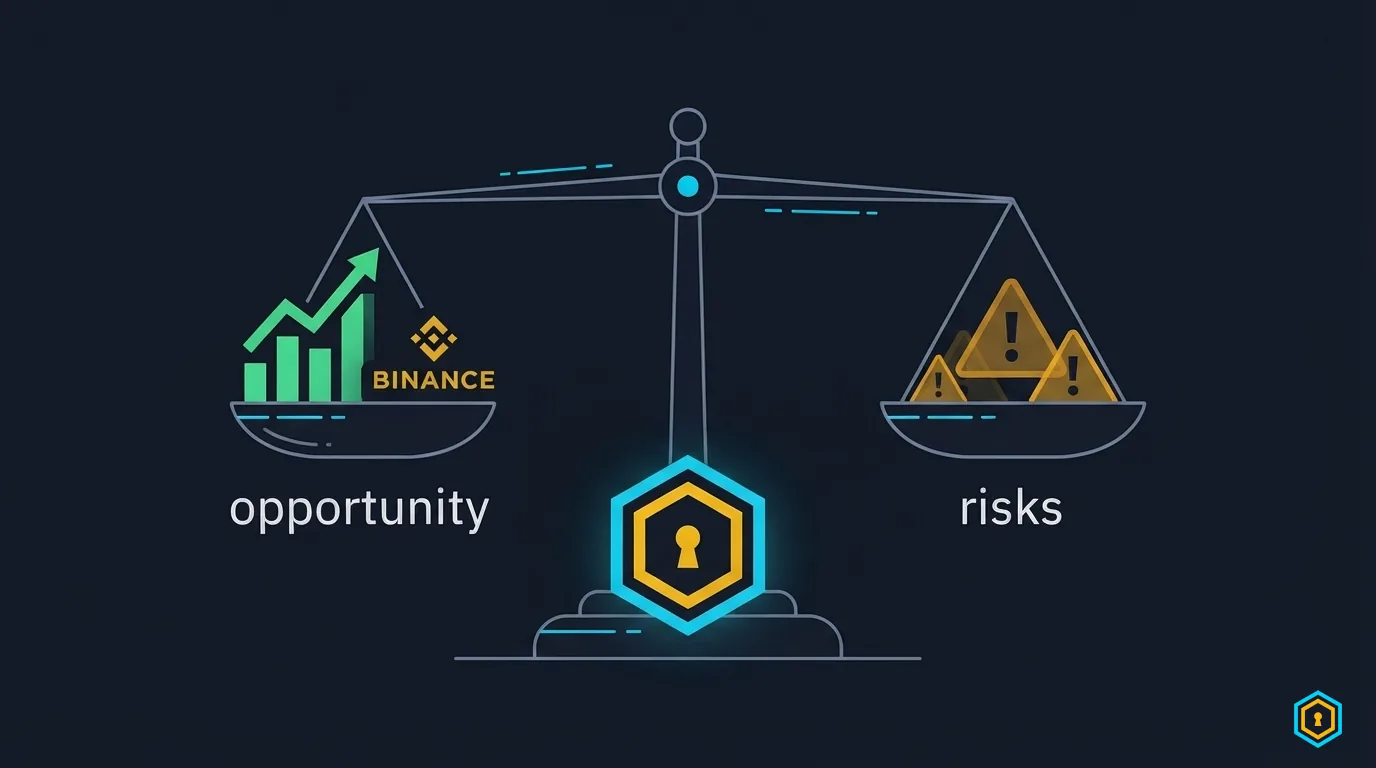
Tokenized stocks carry issuer, delta, liquidity, regulatory, and technical risks, and grant no shareholder rights — mitigate with diversification, position sizing to liquidity, and delta monitoring.
bStocks open equities to the crypto market — but “a token that tracks a share” is not “a share”. Here is an honest look at the risks, no pitch attached.
An honest risk map is not a deterrent — it is what grows a market. Tokenized stocks will scale only if participants understand what they actually hold, and the tools that make those risks visible are as important as the tokens themselves.
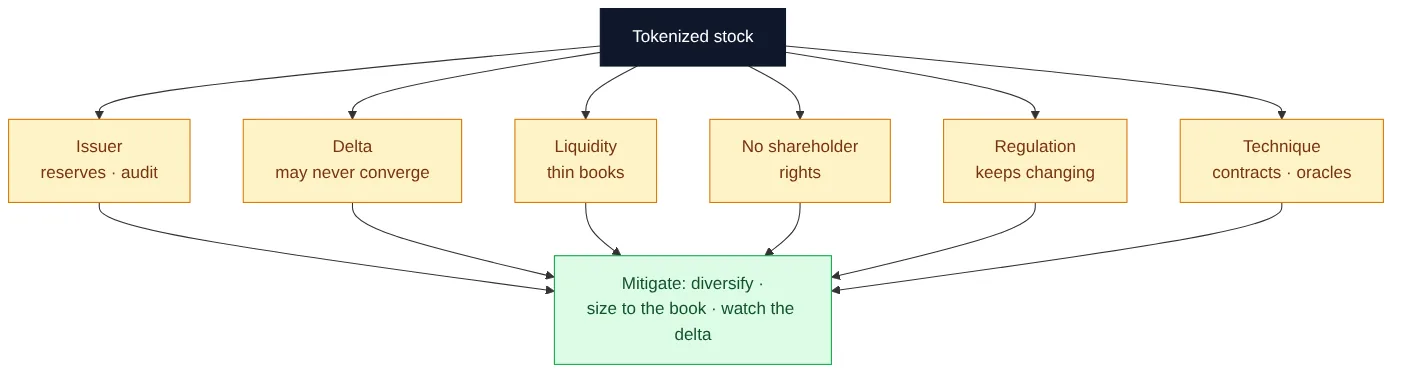
Six risk groups surround a tokenized stock: issuer, delta, liquidity, shareholder rights, regulation, and technique. The mitigation is the same for all: diversify, size positions to the book’s depth, and monitor the delta.
1. Issuer risk
The token is the issuer’s obligation. If the issuer runs into trouble — reserves, regulation, bankruptcy — the token can lose value regardless of the share price. Before buying, check: who the issuer is, how the token is backed, whether reserves are audited.
2. Delta risk
The token’s price can drift from the share for a long time: thin liquidity, weekends, market stress. Buying a “cheap” token may mean waiting weeks for convergence — or never seeing it. A delta that keeps widening is not an opportunity, it is a trap.
3. Liquidity
bStock order books are orders of magnitude thinner than Nasdaq’s. A large order moves the price; exiting quickly and without losses is not always possible. Size positions to the book’s depth, not to your appetite.
4. No shareholder rights
The token usually carries no voting rights and no direct dividends — only price exposure. Corporate actions (splits, buybacks) are handled by the issuer under its own rules. Read the terms before buying.
5. Regulatory risk
The legal status of tokenized stocks differs by jurisdiction and keeps changing. Access can be restricted; rules can be rewritten. Keep positions you can close within a day.
6. Technical risk
Smart contracts, oracles, bridges — every layer adds a failure point. A stale-price oracle or a vulnerable pool are real loss scenarios, not thought experiments.
How to mitigate
Diversify across issuers and symbols. Size positions to liquidity. Monitor the delta — it is both an opportunity signal and an early-warning system (our tracker is one tool for this). And the infrastructure rule: never hold more in tokens than you can afford to lose to infrastructure, not to the market.
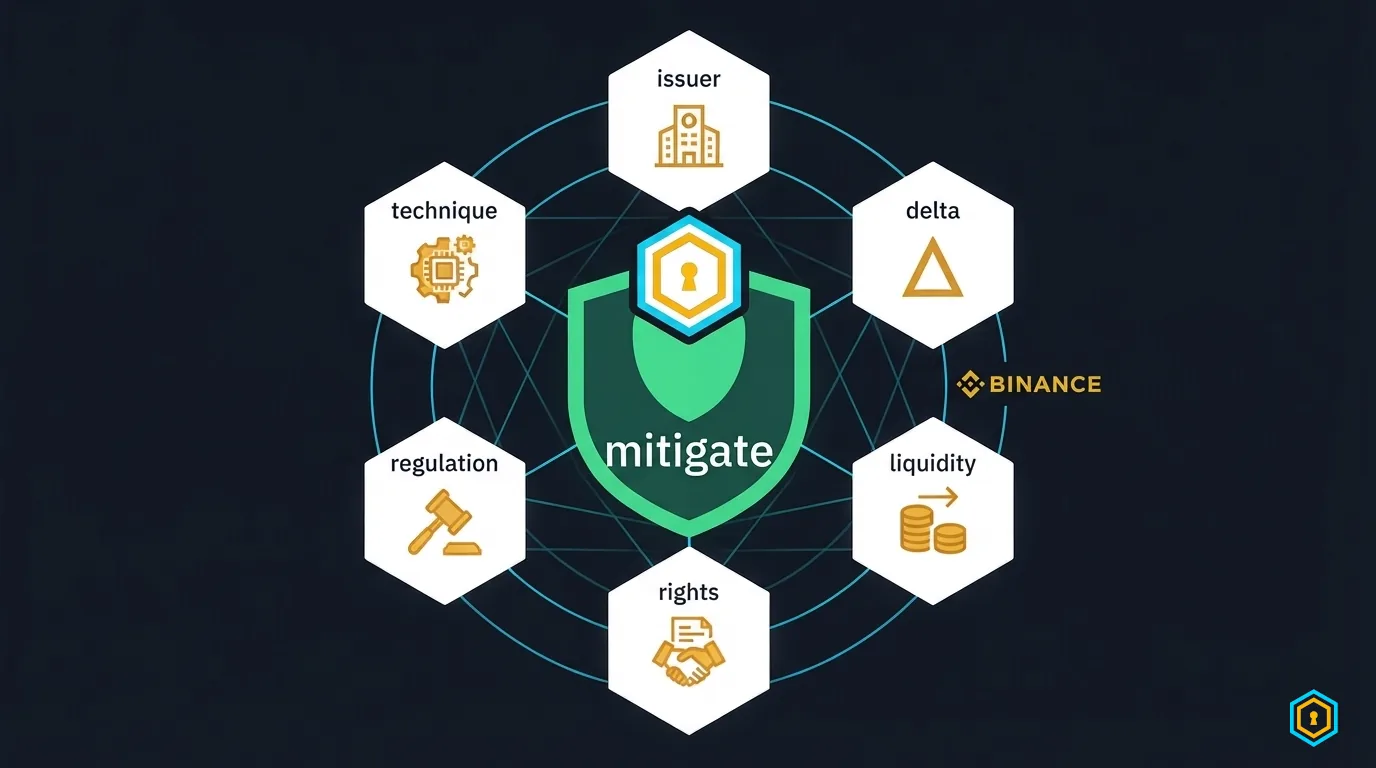
One structural mitigation is already built into the market’s plumbing: paying for data on-chain. A 402 invoice settled on Arc in USDC leaves an auditable trail — the agent’s data spend is as verifiable as its trades. Markets where both the trading layer and the information layer live on-chain are easier to trust.
Tokenized stocks are a powerful instrument — if you understand how a token differs from a share. Start the series with the delta tracker case study.
Links
- Agent guide (endpoints, limits, examples): agentbadge.xyz/bstock-guide
- All articles in the series: agentbadge.xyz/blog
- MCP endpoint:
https://agentbadge.xyz/mcp/bstock/tools/get_delta