Earning Strategies With bStocks: Delta Arbitrage, Market Making, and Alerts
Tokenized stocks live on two markets at once. Delta arbitrage, market making, signal trading, and alerts-as-a-service — four strategies around the price divergence.
The delta between a tokenized stock and its underlying enables four strategies: delta arbitrage, market making on thin pools, signal trading on weekend news, and alerts-as-a-service — profitable while costs stay below the divergence.
A tokenized stock lives on two markets at once: the token on a crypto exchange, the share on a stock exchange. The gap between them — the delta — supports several working strategies. Here is each one, with its risks.
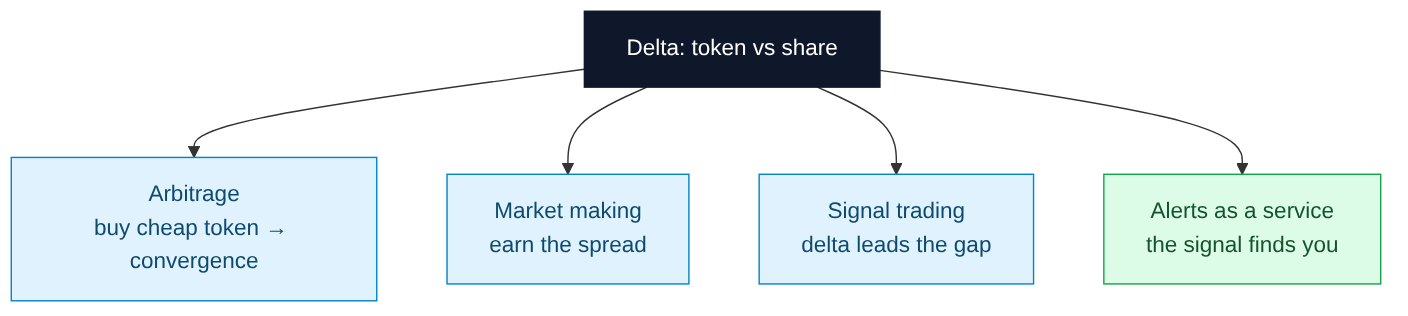
One number, four strategies: arbitrage (buy the cheap token, wait for convergence), market making (earn the spread on thin books), signal trading (the delta leads Monday’s gap), and alerts as a service (the signal finds you).
1. Delta arbitrage
When the token trades below the share by more than your costs (fees + spread + slippage), buy the token and wait for convergence. Classic setup: a −2% delta on a closed exchange → buy the token → exit at parity. The risks: the delta can widen further (cut it with a stop), convergence can take days, and pool liquidity caps your position size. Enter only when you understand why the gap appeared.
2. Market making
bStock pools are thin — wide spreads mean you get paid for providing liquidity. A market maker earns the spread and fees, and the delta hints where quotes should move: token above the share — expect sellers; below — buyers.
3. Signal trading
Delta is a leading indicator. The token reprices on weekend news before the equity market opens. A trader watching the delta knows about Monday’s gap on Saturday — and positions accordingly, with the usual risk that the gap never comes.
4. Alerts as a service
You do not have to trade the delta yourself — monitoring it is a product. Our tracker exposes it over MCP and Telegram: subscribe once, and a message arrives whenever any symbol’s delta crosses the 0.5% threshold. The machine watches; you trade when it matters.
The main rule
Delta is not free money — it is the price of risk: liquidity, issuer counterparty, rebalancing delays. A strategy works while costs stay below the divergence. Count the costs before entry, not after.
Series finale: the risks of tokenized stocks — what can go wrong.
Links
- Agent guide (endpoints, limits, examples): agentbadge.xyz/bstock-guide
- All articles in the series: agentbadge.xyz/blog
- MCP endpoint:
https://agentbadge.xyz/mcp/bstock/tools/get_delta