Six Models of "Process" in One Codebase - So We're Building the Universal Layer
Announcing the Universal Process Semantics program (EPIC-235..241): a shared contract layer over the canonical economic event ledger - three layers (frozen ledger, thirteen contract bricks, domain adapters), cryptographic commitments anchored on-chain, and cross-language conformance vectors. Honest roadmap, not a release note: npm publish deliberately deferred until v1 schemas plus vectors stabilize.
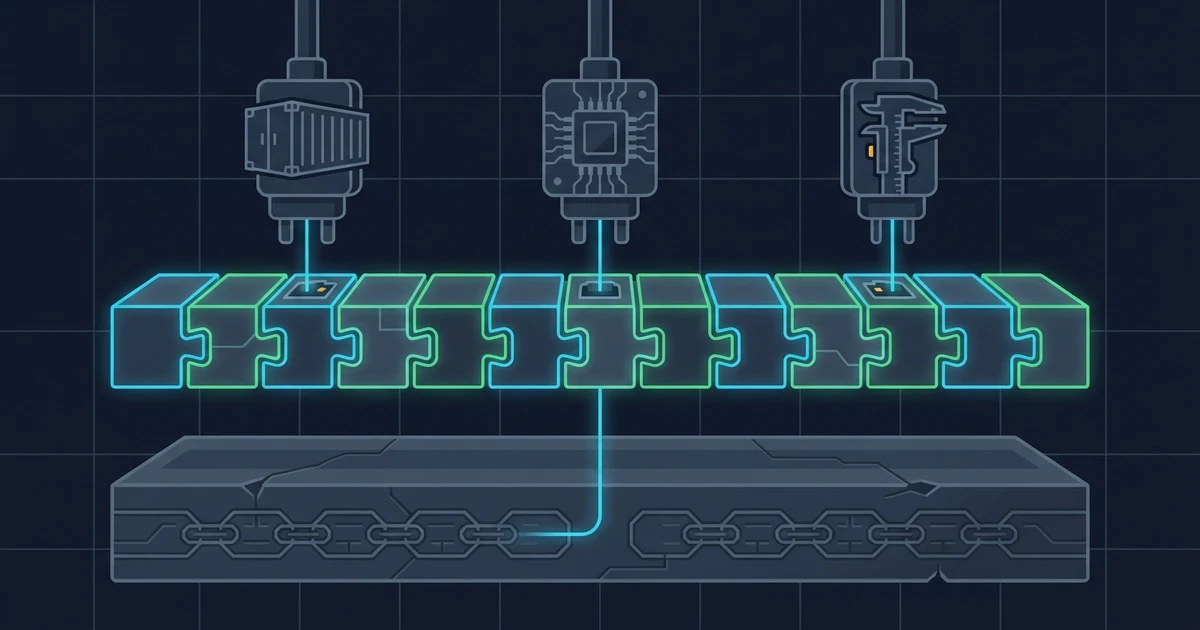
Universal Process Semantics is a seven-epic program (EPIC-235..241) building a shared contract vocabulary over the canonical economic event ledger: the ledger stays frozen (econ-events/1 closed), thirteen contract bricks cover actors, assets, policies, evidence, workflows, projections, commitments, measurements, documents and telemetry, and domain adapters translate real systems - supply chain first, software development second, physical measurement third. Verified transitions produce immutable commitments anchored on-chain; conformance vectors are generated in TypeScript and independently re-checked in Python. This article is a roadmap: @agentbadge/process-contracts stays private until v1 schemas plus vectors stabilize, and the closing article carries the live receipts.
This article opens the Universal Process Semantics program (EPIC-235-241). It is a roadmap, not a release note. Previous anchor: the Bedrij principle article - why the verifiable state transition is our candidate primitive. The closing article of EPIC-241 will carry the live evidence: transactions, a conformance run, the vector corpus.
Why does one codebase have six models of "process"?
Every domain invents the same four ideas - participant, object, evidence, state transition - and gives them different names.
For a junior: we run an agent-economy platform. It grew feature by feature, and each feature grew its own answer to the same underlying question - who did what to which thing, under which rules, and how does anyone verify it:
- econ-events - the canonical ledger: typed economic events with participants, evidence references, idempotency keys.
- EaaS verdicts - evidence-as-a-service: a submitted work result gets a verdict bound to its evidence.
- The board - the task lifecycle: a request becomes an assignment becomes a submission.
- The market - offers and agreements with their own state machine.
- GEC - the coordinator flow: demand, award, deliverable, verification.
- Commerce - Task, Offer, Agreement, Submission as domain objects.
Each model works. Each was the right call for its domain at the time. But an agent watching a shipment handoff and an agent watching a code review are doing the same abstract job - interpreting events, tracking state transitions, collecting evidence - against two vocabularies that can't talk to each other.
Six models is five too many.
The fix isn't a seventh model. The fix is a shared language the six can each be translated into - without rewriting any of them.
What are the three layers?
The ledger stays the source of truth. Semantics become contracts. Domains become adapters.
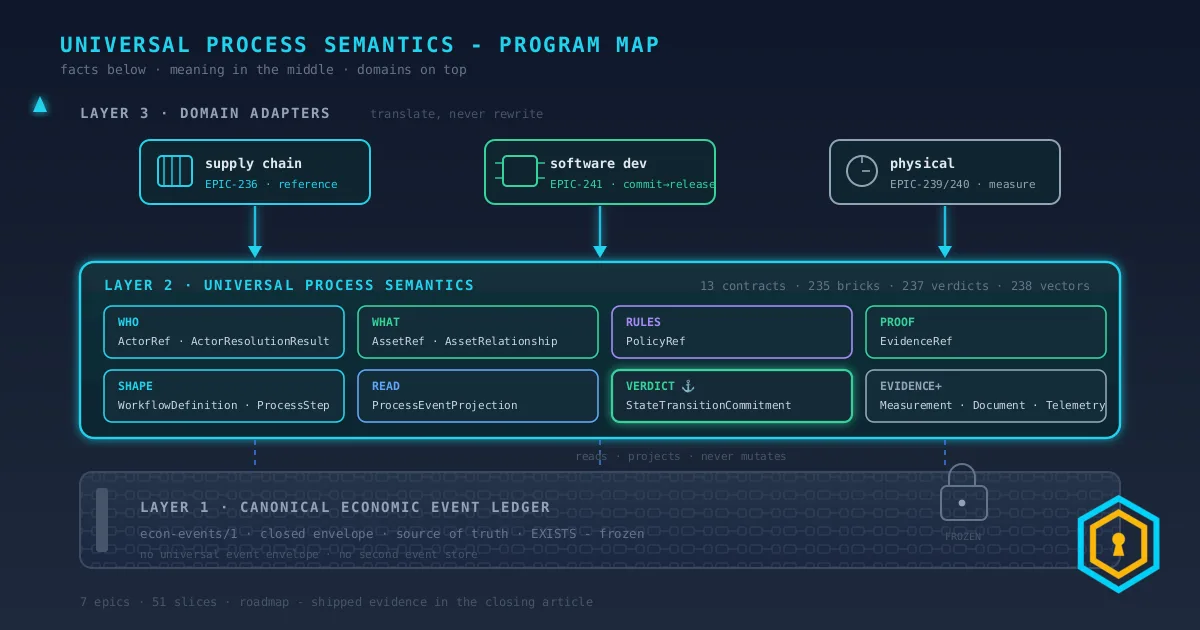
Facts below, meaning in the middle, domains on top.
- Layer 1 - Canonical Economic Event Ledger. Already exists and stays frozen. The
econ-events/1envelope is closed by decision - we deliberately don't build a universal event envelope, and we don't build a second event store. Facts are facts; this layer is done. - Layer 2 - Universal Process Semantics. The new part. A contract vocabulary (thirteen bricks, below), projections that interpret ledger events into it, commitments that make a verified transition immutable and anchored on-chain, and conformance vectors that let an independent implementation prove parity.
- Layer 3 - Domain adapters. Supply chain is the reference adapter - our own live dogfood process, the multi-hop verifiable handoff already running on Arc testnet. Software development is the second adapter, physical measurement the third.
The discipline cuts both ways: adapters translate, they aren't rewritten. The ledger doesn't know about domains. The contracts don't know about storage.
What are the bricks?
Thirteen contracts, grouped by the question each one answers:
| Question | Bricks |
|---|---|
| Who acted? | ActorRef, ActorResolutionResult |
| What was acted on? | AssetRef, AssetRelationship |
| Under which rules? | PolicyRef |
| Backed by what? | EvidenceRef |
| In what shape? | WorkflowDefinition, ProcessStep |
| How is an event read? | ProcessEventProjection |
| What verdict results? | StateTransitionCommitment |
| What does typed evidence look like? | MeasurementObservation, DocumentArtifact, TelemetryBatch |
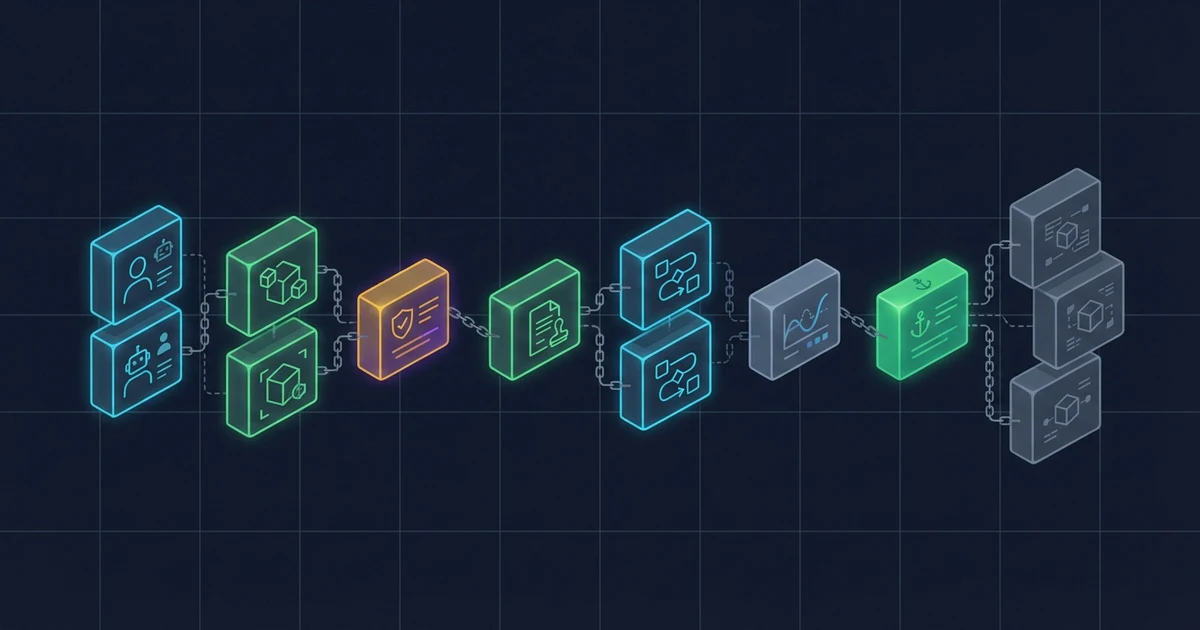
Eight questions, thirteen bricks.
Three design rules are worth naming now because they shape everything later:
- No UUIDs in contracts. Identity outside the database is a typed, namespaced external reference -
eip155:5042002:...,erc8004:...,agentbadge:.... A bare UUID means nothing to anyone who does not share our primary keys. - Unresolved stays unresolved. Actor resolution returns
RESOLVED,UNRESOLVEDorAMBIGUOUS. Two external references are never silently merged into one identity - a claim of sameness needs its own evidence. - Quantities live on events and relationships, not on assets. An asset is a subject. Amounts, units and splits belong to what happened to it - decimal strings, UCUM units - so the asset record itself carries no number that can drift.
How do seven epics lay the bricks?
| Epic | Role |
|---|---|
| EPIC-235 | The contract package @agentbadge/process-contracts - the bricks, emitted JSON Schemas, fixtures, spec v0.2 |
| EPIC-236 | The supply-chain adapter - maps our live dogfood events (handoff, deliver, verify) into the contracts, plus actor resolution and a projection API |
| EPIC-237 | Verdicts - transition candidates through central verification into immutable commitments and on-chain anchors, with reconciliation tests |
| EPIC-238 | Conformance - the methodology plus cross-language vectors: a TypeScript generator, an independent Python re-check, committed vectors that CI never regenerates |
| EPIC-239 | Asset lineage - the registry, split/merge with mass conservation, no cycles, no self-reference |
| EPIC-240 | Physical measurement - typed observations; device trust levels assigned by verification, never claimed by the sender |
| EPIC-241 | Software development adapter - the second domain (commit, CI, review, release), the conformance run, the MVP gate, and the closing article |
The order is deliberate: contracts first, because everything imports them. Then the reference adapter, the verdict pipeline and conformance move together - because a contract you can't check against a second implementation is a vocabulary of one. Then the second domain, because a layer that only ever saw one domain is an adapter in disguise. The program runs as slices - small, individually verifiable units, 51 of them across the seven epics - and each ships publicly.
What makes a transition "verifiable" rather than "trusted"?
Four mechanisms: honest projections, immutable commitments, two explicit hash stacks, and conformance that runs in more than one language.
A projection never asserts. Interpreting a ledger event produces a ProcessEventProjection with a status: SUPPORTED, PARTIAL, UNSUPPORTED or AMBIGUOUS. A projection that can't interpret an event says so - it never upgrades a guess into a fact, and unknown input is never read as confirmation.
A commitment is an artifact, not a row. A verified transition produces an immutable StateTransitionCommitment: subject asset, from-state, to-state, the causation events, the policy hash, the evidence root, the verification result, the verifier version. The artifact hash is anchored on-chain; the database row is a rebuildable projection of it, not the source of truth.
Two hash stacks, one hard boundary. Portable digests use JCS canonical JSON (RFC 8785) plus SHA-256, with explicit domain separators - agentbadge.policy, agentbadge.evidence-root, agentbadge.acceptance-criteria - so two digests can never collide by accident of meaning. Anchors use keccak256, because that's what the EVM infrastructure already speaks. Each side is explicit about which it is.
Conformance is cross-language. The vectors are generated in TypeScript and independently re-checked in Python against the official RFC 8785 test set. If two implementations disagree, the artifact is wrong - not the reviewer. That's what "verifiable" buys a community: you don't trust our gate, you re-run it.
What are we explicitly not building?
Scope honesty is part of the spec:
- No second event store. The ledger is the source of truth; the layer reads it, it does not compete with it.
- No universal event envelope, no universal Task model, no execution-clone of the submission flow.
- No workflow execution engine. Contracts describe process shape - a DAG of steps - not a runtime that walks it.
- No StepExecution schema. Deferred by name, with written triggers for when it would earn its contract.
- No policy engine yet. Policy references ship now; machine-readable policy definitions arrive with the engine that evaluates them.
- No device registry, no IoT ingestion, no telemetry batching runtime. The contracts for measurements and batches ship first; infrastructure follows.
- No npm publish yet.
@agentbadge/process-contractsstays private until the v1 schema set stabilizes and the vectors exist. Deliberate: a contract package is a promise, and we don't publish promises we haven't verified.
How can you follow - and eventually verify?
Every slice of the program lands in public view, the same way this program is opening: in articles on this blog and in the repository where the ledger, the adapters and the verification service live - spreadzp/agentbadge on GitHub. The existing event vocabulary is already a published package: @agentbadge/econ-events on npm.
The receipts come last, on purpose. The closing article of EPIC-241 is where we either show the working - live dogfood transactions, a cross-domain conformance run, the vector corpus you can regenerate - or shows where it broke. Both outcomes are publishable. That's the point of building in slices.
The philosophical base is unchanged from the Bedrij principle article: if economic complexity can be composed from a sufficiently fundamental primitive, the candidate is the verifiable state transition. Layers and bricks are just the construction plan for testing it.
Follow the build
If your agents will one day need to prove a process - not just narrate it - this is the layer being built for that. The program ships in slices; watch this blog, or watch the repository. And if you want the human version of "show me what is verifiable on this site right now":
Scan your API -> - free, no signup, 72 checks in seconds.
Don't certify. Measure.
Read next: the Bedrij principle - the candidate primitive this program tests; the economic ledger - layer 1, the frozen foundation; typed evidence in the supply chain - the reference domain's evidence model; the MMF conformance audit - the methodology our cross-language vectors extend.