Free vs Real-Time: Why an Agent Should Pay for bStock Data
One request per minute is a snapshot; real-time is a signal. Why the paid tier of a bStock delta tracker is infrastructure, not an expense.
Free tier gives one snapshot per minute; the paid tier gives unlimited polling, Telegram alerts, and a 30-day ServicePass — for an agent that trades or alerts on tokenized-stock deltas, real-time data is infrastructure.
The bStock delta tracker has two tiers: free (1 request per minute) and paid (real-time, 5 USDC for 30 days). A fair question from any trader: why pay when free exists?
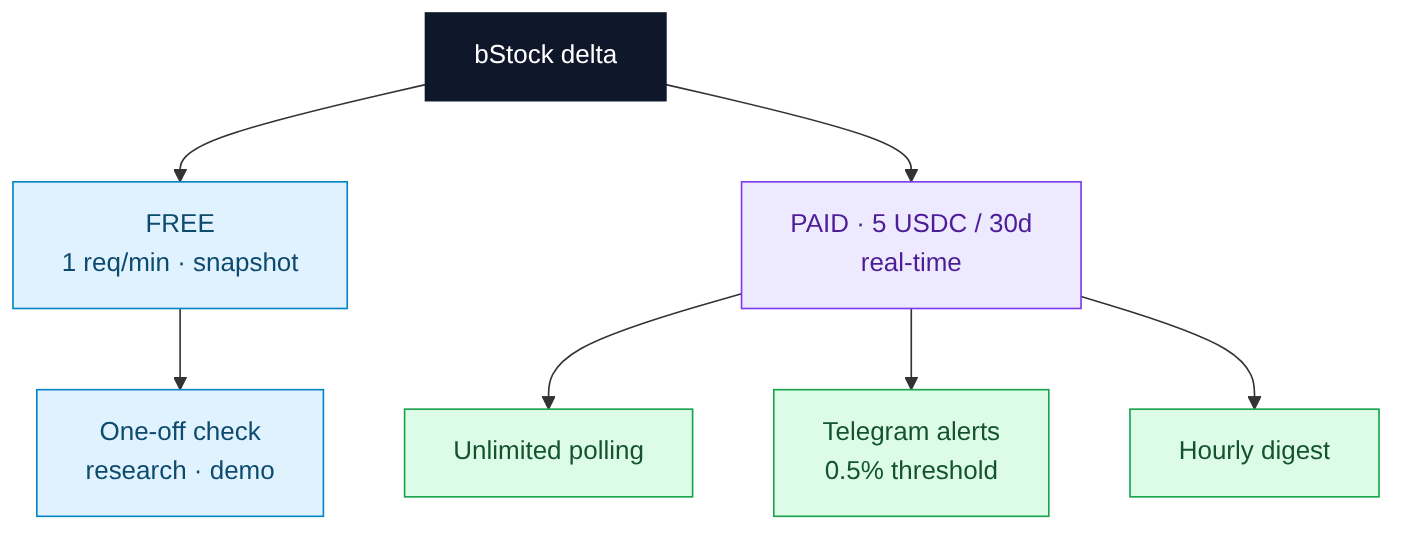
The free tier is one request per minute — a snapshot for a one-off check or research. The paid tier (5 USDC for 30 days) is real-time: unlimited polling, Telegram alerts at the 0.5% threshold, and an hourly digest.
What the free tier gives
One request per minute is a snapshot. Ask “what is AAPLB’s delta” — get an answer. For research, a one-off check, a demo — enough. But between requests there is a minute of blindness. And delta lives exactly in those minutes.
What the paid tier gives
- Unlimited requests — poll every second if your strategy needs it.
- Telegram alerts — the tracker messages you when a delta crosses the 0.5% threshold. No polling at all; the signal finds you.
- Hourly digest — a summary of everything that happened while you were away.
- A 30-day ServicePass — one payment, a month of access, proof on-chain.
When the delta turns into money
Three scenarios where a minute of blindness costs more than the subscription:
- Weekends. News drops on Saturday — the equity reacts on Monday, the token reacts now. A −3% delta on a closed exchange is advance information about Monday’s gap.
- Earnings. The report lands after the call — the stock is still in its auction, the token has already repriced.
- Thin pools. One large order moves the token an hour before liquidity rebalances — the window opens and closes by itself.
In all three, the edge is not “seeing it eventually” — it is seeing it first.
Agent economics
5 USDC for 30 days of real-time is ~0.17 USDC a day. One caught arbitrage window on a tokenized stock pays for years of subscription. For an agent that trades or alerts on deltas, the paid tier is not an expense — it is infrastructure, like a market data feed.
Next — the educational block: what bStocks are, for people new to tokenized stocks.
Links
- Agent guide (endpoints, limits, examples): agentbadge.xyz/bstock-guide
- All articles in the series: agentbadge.xyz/blog
- MCP endpoint:
https://agentbadge.xyz/mcp/bstock/tools/get_delta